
On November 19, the Council of the European Union approved conclusions on the skills people need to engage with artificial intelligence. It calls on member states to use existing European frameworks when revising curricula and assessment, to support teachers from initial training through their working lives, and to make learning available to workers and adults. It also asks the European Commission to develop cooperation, evidence and frameworks beyond primary and secondary education. The conclusions describe a common policy direction. Decisions about particular courses, providers and assessment still have to be made through the education systems that will use them. Council announcement · Conclusions on skills and competences
The hard part is deciding what people should learn once they have access to the tools. A student can make a chatbot produce a summary in seconds. A worker can use the same tool to draft a reply, and a resident can receive a message written by a system without seeing the system. Each person needs to know different things. Who produced the output? What evidence can be checked? Who decides whether the proposed action happens? A reasonable definition of literacy includes enough understanding to answer these questions alongside the ability to use the interface. That is the part of the Council’s agenda that could make a difference beyond any one software product.
Exposure and competence need separate measures#
Eurostat offers a baseline for exposure. In its 2025 survey of household and individual use of information and communication technology, 63.8 percent of EU residents aged 16 to 24 reported using generative AI tools in the preceding three months. The share was 32.7 percent across the survey’s 16 to 74 age range. Eurostat’s analytical report puts the share at 6.5 percent for people aged 65 to 74. These percentages tell us about declared recent use in the selected age groups. They do not measure how often someone checks an answer, which resources are available in a particular school or the current habits of children below the survey’s age range. Eurostat survey analysis by age · Eurostat’s analytical report
The gap between age groups gives a policy a place to start asking questions. It may reflect need, access, the kinds of jobs people hold, available help or a deliberate choice to avoid the tools. A usage chart alone cannot distinguish those reasons. Nor should an education programme decide that a frequent user already knows how to check the source of a plausible answer. A training provider can use a short practical task to learn what different participants arrive knowing. A person who already uses a model may need better criteria for deciding when to trust it. A person meeting one for the first time can often bring domain knowledge that the regular user lacks. The two learners can need different support.
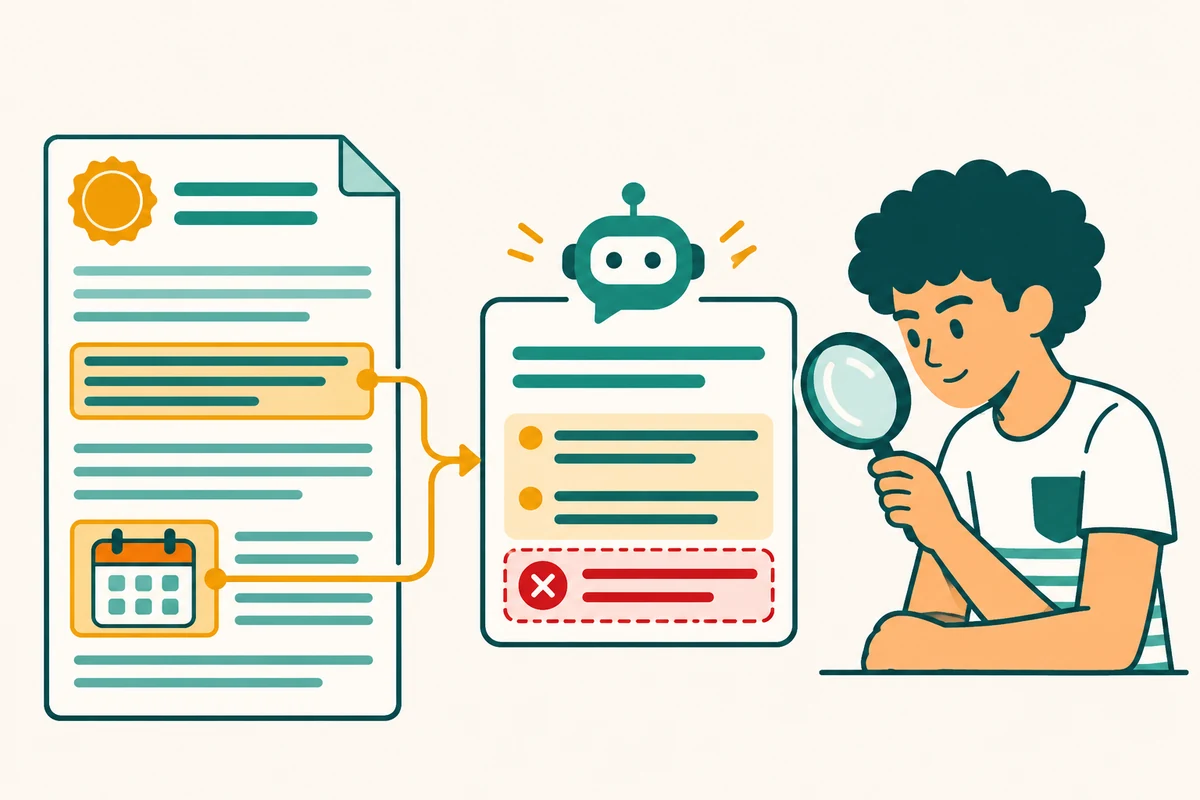
Consider an adult looking at a notice about a public service. A chatbot can turn its formal language into a few readable sentences. A useful exercise asks the learner to find the relevant original passage, retain the eligibility conditions and check the effective date. If the answer omits an exception, she should be able to see what was lost and where to ask about it. Scoring whether she obtained a fluent summary would miss most of the skill. A course can instead observe whether she kept the distinction between the official document and the tool’s explanation. The method works in a classroom or library and remains usable after the name of the tool changes.
The Council’s text makes room for safe, critical and responsible engagement. It describes human decision-making, rights and inclusion alongside opportunities for learning and employment. Those aims set a higher bar than distributing account access. It should be possible to become more confident without using AI for every activity. For some tasks a person will choose a calculator, a library search or a conversation with an expert because that route gives a reliable answer with fewer complications. An assessment can recognize good judgment about tool choice. If a programme gives credit only for using a system, it loses evidence of a useful decision a learner made independently. Council conclusions on human agency and inclusion
It also helps to define which systems the training covers. A workplace may introduce a text assistant and already use a model to prioritize requests. A school may teach about generated images without asking students to create one. Both can be part of literacy because people encounter decisions and outputs in different ways. A definition that covers checking, interpretation and the choice to disagree can work across these examples. It leaves room for a specialist programme to teach technical methods while a general course teaches people how to recognize a consequential claim and obtain help. Using a common name for the subject need not imply an identical treatment for every age or occupation.
Schools need to decide what the student should do#
The European Commission and the OECD published a literacy framework for primary and secondary education in June 2026. It gives schools a basis for activities and learning outcomes. That earlier work differs from the November conclusions, which ask governments to look across education levels and types. A school can use the framework to choose age-appropriate exercises and adapt them to its curriculum. The choice of activity should follow the purpose of a lesson. Learning to check a map, to write an argument and to examine how a model generated a claim may all involve reading. They require different evidence of what the student understood. OECD and Commission school framework
The same model can change a task in different ways. In a writing class, an automated outline might remove a step the student is supposed to practise. In a later assignment, checking an automated outline against two primary sources can be the task itself. Students should know what kind of help is allowed and what they need to explain in their own words. A rule can ask them to submit a citation or comparison without demanding access to every draft or private conversation. A clear distinction between the practice period and the evaluated task helps teachers hold the same standard for students with different access to technology at home.
Assessment deserves attention because polished output can hide a weak understanding. A student might produce an accurate paragraph by combining good sources, or receive one without knowing how to tell if it is right. An educator can ask students to explain one choice, identify what changed after checking a source and apply the same reasoning to a new example. The question is whether the learning survives a change of tool and whether the student can repeat it without help. Those observations give a more direct view of learning than an attempt to guess the software that produced a sentence. They also allow a student with an accessibility aid to demonstrate the same underlying knowledge.
Access can determine who gets to practise. Some families have up-to-date devices and paid accounts. Others have limited connectivity, share a device or need an interface in a less widely supported language. A teacher can reduce differences by providing the same materials in class and keeping a comparable path for someone without an account. An evaluation can examine whether students had enough time and whether the provided interface was usable with assistive technologies. The Council encourages member states to address gaps in participation, access and language. A school that follows that direction should be able to find data on which learners could take part, before looking only at class averages. Accessibility and participation in the Council conclusions
Schools will also face questions from families about data. A teacher might want a system to suggest discussion questions from a generic passage. Asking students to upload personal reflections into the same system changes the information involved and the expectations of families. An acceptable classroom activity should be clear about which service is used, what goes into it and where the teacher makes the final decision. A school can use examples with synthetic or public text for training. If a tool handles student material, the institution remains responsible for explaining the arrangement, providing a useful alternative where appropriate and dealing with errors or concerns that arise.
Differences among subjects matter as well. A science class can ask students to check a generated explanation against observations gathered during a lesson. A language class can ask them to decide whether a suggested change preserves a sentence’s meaning and register. A civic education activity can ask where a claim about a public institution originates. None of these needs a new subject to be meaningful. A shared approach can provide the sequence of actions, while teachers choose evidence their subject already values. This avoids giving the same narrow skill several names and makes it easier to see whether young people can transfer it between settings.
Educators need supported time to develop judgment#
The Council calls for teachers and educators to develop their skills during initial training and continuing professional development. It highlights peer learning networks and communities of practice. The practical lesson from that choice is that a teacher needs chances to compare work with colleagues. A short demonstration can show how to ask for a lesson plan. A group can go further by comparing plans, finding unsafe or unsuitable assumptions and marking which changes would improve them. It can keep anonymized examples for future teaching. To get the benefit, institutions need time for review as well as time for the original lesson. Council announcement on teacher development
A teacher also needs a reason to use the technology for a given class. Drafting an initial worksheet may reduce preparation time. Checking its examples for accuracy, bias and age suitability may take some of that time back. The useful test is the result of the whole process. An educator could compare a lesson prepared in the usual way with one prepared through the tool and record review time, which exercises survived and how well learners understood. Conventional materials should remain available. This creates evidence about a teaching decision, rather than comparing one polished worksheet with another after the work behind each has been forgotten.
Training can also make room for uncertainty. A tutor may see that a generated answer misses an important part of a local history topic. Another specialist may understand the source but have little experience with the interface. Peer use can bring those skills together. An educator should be able to record a failure, ask a colleague for help and decide to change the task without treating that decision as a lack of fluency. A programme that collects only positive examples teaches staff to repeat them. One that preserves mistakes with clear context shows what students and teachers need to check in a similar situation.
Institutional responsibility remains distinct from teacher confidence. A school leader can set rules about approved tools, personal information and when to consult someone with more expertise. A teacher can decide whether a tool suits a learning activity. A vendor can provide change notes and documentation that affect that decision. Putting all responsibility on the person who happens to open the interface makes those roles harder to see. Where test scores or access to a service are at stake, the person affected needs a clear way to ask for a reason, a correction or a human decision. Shared policies can help teachers know where to take a concern.
Professional development also needs a way to recover when the tool changes. A teacher may plan a lesson around a feature that is no longer available, or the service may change its wording or the way it keeps examples. A reusable exercise can describe the input, skill and evidence without depending indefinitely on a menu label. A school can keep a small set of approved scenarios and check them when the service changes. It can also ask educators how often they have to adapt a lesson because of the product. That evidence matters to institutions weighing the continuing time required to offer training, even after the first cohort has completed it.
Workers and adults meet different choices#
The Council calls on governments to encourage higher education and vocational providers to adapt programmes and provide advanced AI skills, as well as continuing education, upskilling and reskilling. A vocational exercise should start with a decision a learner has to make at work. A technician can compare a generated maintenance summary with the relevant manual and decide what must be checked by a supervisor. A care administrator can find where a draft changed the meaning of a rule and remove sensitive material before using a service. The details depend on the occupation. The transferable part is learning to inspect a suggested action and knowing who can authorize it. Council conclusions on higher education, VET and adult learning
An employer may judge a training programme by the number of accounts activated or people completing a course. Those are reasonable process measures. They should be accompanied by what the person can do and the time they have to do it. Consider a support worker given a draft reply with an invented promise. The worker needs time to check policy, an interface that lets them change the draft and authority to ask a colleague before sending it. A user who identifies the problem but cannot stop the process has exercised judgment with little practical effect. Evaluation can therefore include observations of the surrounding workplace as well as the answer on an assessment sheet.
For adult learners outside the workplace, the same course may need more entry points. A public library might offer help comparing information sources. A further-education provider can give a longer course linked to a qualification. A community group can reach residents who use different languages or cannot attend during standard hours. The Council recognizes non-formal and informal learning as routes to develop skills. Those routes can reduce participation barriers. Judging reach requires the right denominator. People who enrolled and finished are one group. People who could benefit but did not attend are another. A service can find out why through participants and groups that work with them. Learning routes in the Council’s conclusions
The lessons should transfer to people encountering automated material they did not request. A tenant may be sent a generated summary of a lease condition. A trainee may receive a score calculated from a submitted exercise. An employee can be asked to follow a generated plan. In these situations, a practical skill is to distinguish the statement from the evidence and know where to raise a consequential mistake. A provider or employer still has duties for the systems it chooses and the decisions it allows them to influence. Public education can help people exercise oversight. It cannot substitute for access to the relevant records, an appeal process or a person accountable for the action.
A useful distinction in workplace training is between competence of a new recruit and permission to carry out a specific task. A worker can be good at checking a generated calculation and still need a supervisor to authorize a change to a customer record. A document can say which stages are educational, which take place on prepared examples and which allow a person to act on real information. That lets a learner practise mistakes without exposing someone else to the result. It also gives the employer a concrete opportunity to observe how people act when the proposed output looks reasonable but supporting evidence is missing.
A public programme should show how it knows people learned#
The Commission’s separate education communication proposes age-appropriate reference learning outcomes and guidance on assessment by mid-2027, using the school framework as a basis. The Council asks for cooperation, evidence and frameworks beyond schools. A reader should track who owns each of these steps and what the timetable means in a member state. Issuing guidance and offering a course are different milestones. Observing whether a teacher, learner or worker can apply the skill is a later one. Local pilots can show what is usable before someone decides that every education system should measure it in the same way. Commission education and skills communication
An evaluation can start from several comparable tasks. Ask a participant to identify a claim, trace it to an original source, detect an unsupported detail and explain whether they would act. Later give them a different document or interface to see whether they can transfer the method. Record the participants, learning time, assistance and comparison group. A quicker answer without better checking may matter for a low-risk activity, while a slower answer that avoids a dangerous omission may be preferable for another. Defining the intended outcome before selecting the model keeps the programme from counting whichever measure happened to improve.
A useful public report would give results alongside participation and access. It can show which sessions were available in each language, which learners reached them and what differences appeared after instruction. It can separate participant observations from statements about a whole age group. It can also describe the time and support educators needed to deliver the programme. This lets other providers understand the cost of reproducing it. If an activity appears to work for a narrow group, a report can specify its limits and identify what would need checking in another context. That is a more meaningful form of cooperation than sharing a catalogue of courses alone.
The evidence ought to account for people who choose another way to complete the task. A learner who declines to put a sensitive document into an unfamiliar service may have applied the lesson well. A worker who checks a calculation manually can still demonstrate that she understands the limits of a generated answer. A person who needs accessibility assistance should be able to show the same judgment through another interface. An assessment that observes reasoning and recognizes these decisions will describe skills better than software activity alone. It also gives public programmes a way to improve access while keeping judgment, rather than frequency of use, as the central outcome.
The November conclusions put responsibility across a lifetime. The question to follow is what people can do once systems are in classrooms, offices and public services. Students should understand the material they hand in. Workers should be able to reject a mistaken suggestion. Adults encountering generated information should know where to find the underlying reason and whom to ask. More opportunities to practise can help them do those things. The next evidence of progress will be an education programme that can show who gained those skills, who could not participate and what changes would allow them to do so.